It usually happens at the dinner table. Someone mentions an old friend, and the face comes back right away. The house, the laugh, the summer you met. The name does not. A few seconds pass, the conversation moves on, and the name shows up an hour later in the car.
Sometimes it is a story instead of a name. Everyone at the table laughs, and one person laughs a half second late, because they caught the tone and not the punchline. Nobody says anything. But someone notices, and starts speaking a little more slowly, the way people do with someone they have quietly started to worry about.
The three moments people mention most
Ask people over 50 what they notice first, and the answers are remarkably similar:
- Walking into a room and forgetting why they came in.
- Looking at someone they have known for years and waiting for the name to arrive.
- Reading the same paragraph two or three times before it sticks.
Most of us file these moments under "getting older." Doctors often say the same thing, and it is usually meant kindly. But for a lot of people, the worry underneath is not about a name. It is about being treated differently. About still being fully there, and wanting the people around them to keep seeing that.
A library, not a hard drive
The team behind a new liquid supplement called CogniClear starts from a different picture of memory. They describe it as a library.
The books are still on the shelves. What slows down is the path to them.
In that picture, a forgotten name is not a deleted file. It is a book that is still on the shelf, in a corridor that has become harder to walk through. Which raises a practical question: what keeps the corridors clear?
What researchers found in 2025
In early 2025, a team from the University of New Mexico published a study in Nature Medicine reporting microplastic particles in samples of human brain tissue. Samples collected in 2024 held noticeably more plastic than samples collected in 2016.
It fits a larger pattern. In 2022, researchers in Amsterdam detected plastic particles in the blood of most of the healthy volunteers they tested. In 2024, a Columbia University team estimated that a typical liter of bottled water carries hundreds of thousands of tiny plastic fragments.
To be clear, no one has shown that these particles cause the everyday memory lapses people notice. Scientists are still working out what they mean for long-term brain health. But the findings pushed the CogniClear team toward one question: if more is getting in, what helps the brain keep its paths clear?
The brain's night shift
The brain has its own cleaning system. Researchers at the University of Rochester described it in 2012 and named it the glymphatic system. It works mostly while we sleep, flushing fluid between brain cells and carrying waste away.
Memory also depends on a chemical messenger called acetylcholine. In the library picture, acetylcholine is the librarian: the one who walks the aisles and brings the right book back when you reach for it. The body keeps acetylcholine in balance with an enzyme that breaks it down once its job is done.
Clear paths and a working librarian. Those two ideas are what the CogniClear formula is built around.
Four ingredients, one dropper
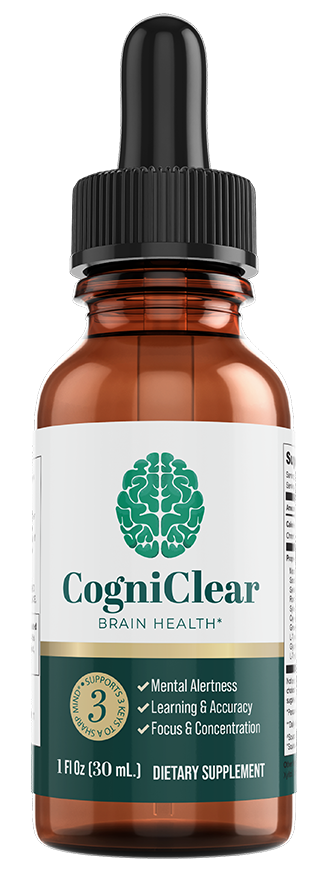
CogniClear combines four ingredients, each chosen for a different part of that picture:
- Eucalyptol (1,8-cineole). The compound behind the cooling scent of the chest rub in many American medicine cabinets. Lab research has looked at how it interacts with the enzyme that breaks down acetylcholine. In a 2012 study at Northumbria University in England, people who breathed in rosemary aroma, which is rich in 1,8-cineole, had blood levels of the compound that tracked with how well they did on speed and accuracy tests.
- Phosphatidylserine. A fatty compound found in every cell membrane and concentrated in the brain, where it is part of the membranes nerve cells use to send signals.
- Lion's mane mushroom. Used for centuries in Japan. Its compounds have been studied for their link to nerve growth factor, a protein brain cells use to build connections. In a small 16-week study in Japan with adults aged 50 to 80 who had mild memory complaints, those taking lion's mane scored higher on a cognitive scale than those taking a placebo, and the difference faded after they stopped.
- Bacopa monnieri. An herb used in the Ayurvedic tradition for about 3,000 years. In several 12-week clinical studies with healthy adults, it was associated with better recall of new information.
Most memory products on the shelf are built around a single ingredient. CogniClear puts four in one bottle, so the routine is one dropper instead of four bottles, taken in about ten seconds each morning. No pills to swallow.
Why the team recommends three months
The studies behind these ingredients did not run for a week. The bacopa studies ran 12 weeks. The lion's mane study ran 16. Ingredients like these are studied over months, because months is the timeframe in which researchers look for changes.
That is why the 3-bottle option, a 90-day supply, is the one the team recommends. It is also why the guarantee runs 90 days: long enough to follow the full routine and decide for yourself.
What it is, and what it isn't
CogniClear is a dietary supplement, not a medication, and it is not meant to replace anything a doctor has prescribed. Anyone who takes prescription medication, is pregnant, or has a medical condition should talk to their doctor before starting a new supplement.
What it offers is simple: four studied ingredients, one dropper, ten seconds in the morning, and 90 days to see how it fits into daily life.
Most of us will keep filing those dinner table pauses under "getting older." The routine is built for the next family dinner instead, when an old trip comes up and the name of that little town is there when someone asks.
How to try CogniClear
Choose your supply below. Each bottle lasts 30 days, and every order is covered by the 90-day money-back guarantee.
90-day money-back guarantee. If you are not satisfied, email the company within 90 days and get a full refund.
Shipping. Orders arrive in 3 to 5 business days, in discreet packaging, with a tracking number.